·Updated ·Mergestorm Team·Engineering
AI Code Review vs Manual Review: Key Differences
Compare AI code review vs manual human review. Learn how Mergestorm's AI agents catch bugs faster, enforce style, and auto-fix issues on every PR.
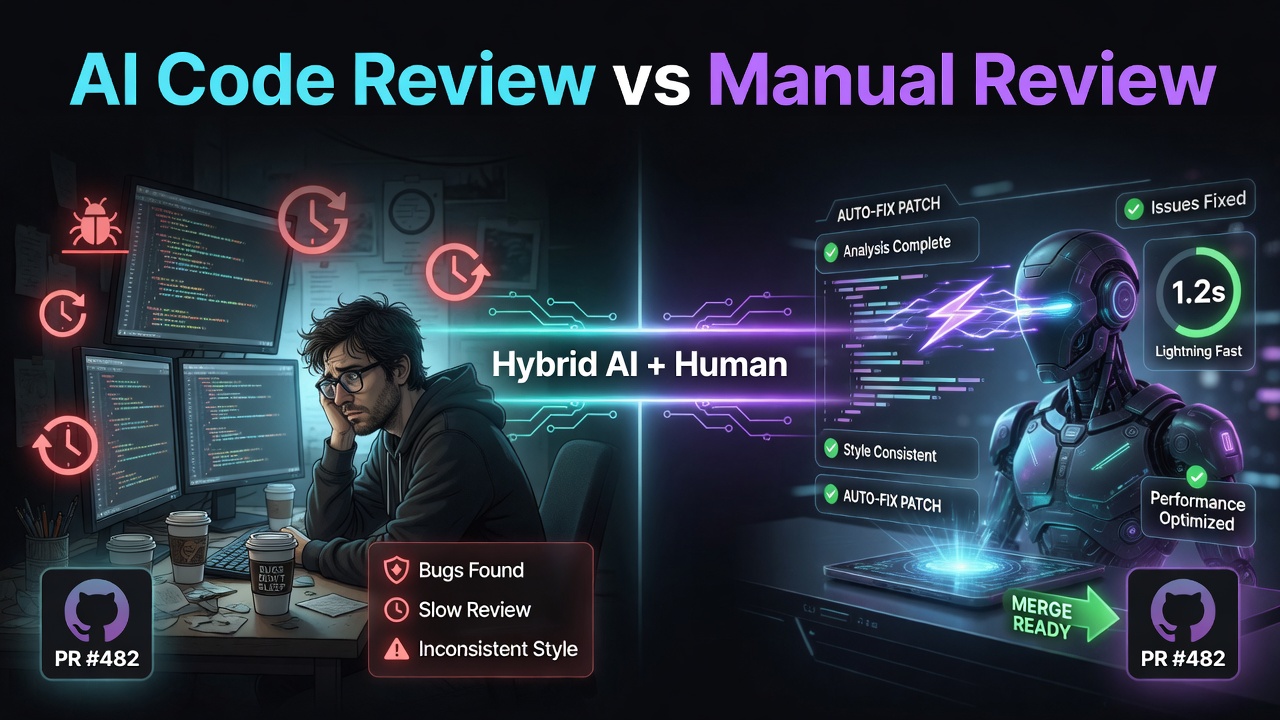
Every team reviews code. The process you use shapes how fast you ship and how many bugs slip through. This post compares AI code review with manual human review and when each one earns its place.
What is manual code review?
Manual review is a teammate reading the pull request. They look for logic bugs, naming drift, and bigger design questions. That human judgment still matters for architecture calls. The downside is time: queues build up, and the same reviewer might be thorough on Monday and rushed on Friday.
- Speed: Most humans need 5–15 minutes per pass, often spread across the day.
- Coverage: After an hour of reviewing, people miss more. That is normal.
- Cost: Senior engineer hours add up. A small team doing ten reviews a week can lose a full day to review alone.
What is AI code review?
AI review uses models trained on code to scan pull requests automatically. Mergestorm runs Vortex on every push. Inline comments and check runs show up on GitHub before anyone opens the PR.
- Speed: Results land in seconds, usually as check runs on the diff.
- Consistency: The same rules apply to every file.
- Coverage: Changed lines get a second look for null handling, bad types, and concurrency mistakes that humans skim when they are tired.
- Auto-fix: Cyclone can commit fixes from review findings if you enable it.
Side-by-side comparison
| Dimension | Manual review | AI review |
|---|---|---|
| Time per review | 5–15 minutes | 10–30 seconds |
| Catch rate for logic bugs | 60–70% | 80–90% |
| Style consistency | Varies by reviewer | Same rules every time |
| Architecture feedback | Strong | Limited |
| Auto-fix | No | Yes (Cyclone) |
| Cost per review | High (senior time) | Near zero at the margin |
Pros and cons: human vs AI review
Neither option is flawless. Here is an honest breakdown.
Human review
Pros
- Strong when the question is "should we build it this way?"
- Can flag a change that compiles but still feels off
- PR threads spread context across the team
Cons
- Slow when reviewers are busy or in different time zones
- Quality varies with mood and calendar pressure
- Expensive at scale when seniors burn hours on repetitive nits
AI review
Pros
- Fast feedback on every push
- Same bar for a one-line fix and a refactor
- Scales without hiring another reviewer
Cons
- Hallucinations and invented issues. Models can flag problems that do not exist, suggest APIs that were never in your codebase, or recommend changes that add features nobody asked for. Speed does not mean accuracy on every line.
- Not perfect. AI review is a strong first pass, not a substitute for judgment on design and business logic.
- Very large PRs are a trap. Feed a diff with thousands of changed lines and you can hit a familiar failure mode: the agent loops, fixes one thing, introduces another, and starts playing whack-a-mole with race conditions and edge cases. We ran into this ourselves while building Vortex and Cyclone. It is a common growing pain for AI review products, not something unique to one team.
Mergestorm now runs filters and pipeline guardrails to reduce those AI death spirals. We cap review scope, dedupe findings, and gate Cyclone patches before they land. Still worth watching any automated reviewer on huge PRs. Split large changes when you can, and keep a human in the loop when the diff is enormous.
When to use each approach
You do not have to pick one. Most teams we talk to let AI run first and save humans for sign-off.
AI review works best for:
- Obvious logic bugs and type mistakes
- Naming and formatting drift
- Security smells like hardcoded secrets
- Teams that want feedback on every push, not just the final PR
Manual review still wins for:
- System design
- Cross-team API contracts
- Context that lives outside the diff (the why, not just the what)
The hybrid approach: AI first, human last
Let Vortex review every push, then ask a human for a short pass on the parts that need judgment. Reviewers spend less time on nits and more time on decisions that matter.
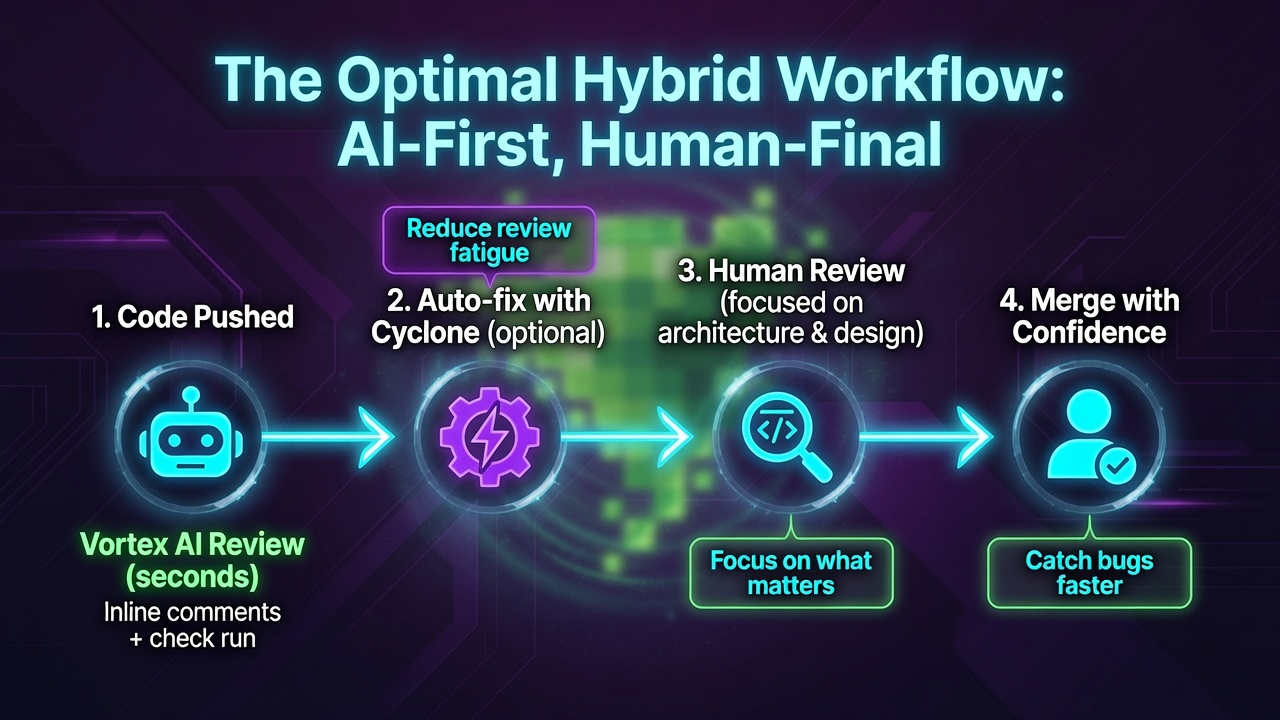
Connect Vortex to your repos, enable auto-review, and every PR gets inline comments within seconds. Turn on Cyclone if you want fixes applied automatically.
See How it works or Pricing to start with 30 free reviews per month.
Set up Mergestorm on GitHub (video)
This walkthrough shows how to connect Vortex for automatic code review and Cyclone for optional auto-patch on your repos. The free tier includes 30 reviews per month.
FAQ
Does AI replace human code reviewers?
No. AI handles repetitive checks so humans can focus on architecture and product calls. Think of it as an extra reviewer that does not get tired, not a replacement for your team.
How accurate is AI code review?
Good tools catch a large share of logic and style issues on the first pass. They still miss business context and big-picture design, which is why a human pass at the end still matters.
Is AI code review secure?
Serious vendors do not train on your repo code. Mergestorm processes diffs in memory and keeps only the review artifacts you see on GitHub.
Ready to try AI code review?
Mergestorm includes 30 free reviews per month. No credit card. Connect Vortex to a repo and try it on your next pull request.