·Updated ·Mergestorm Team·Engineering
Vortex V2: From One Fast Reviewer to a Fleet That Converges
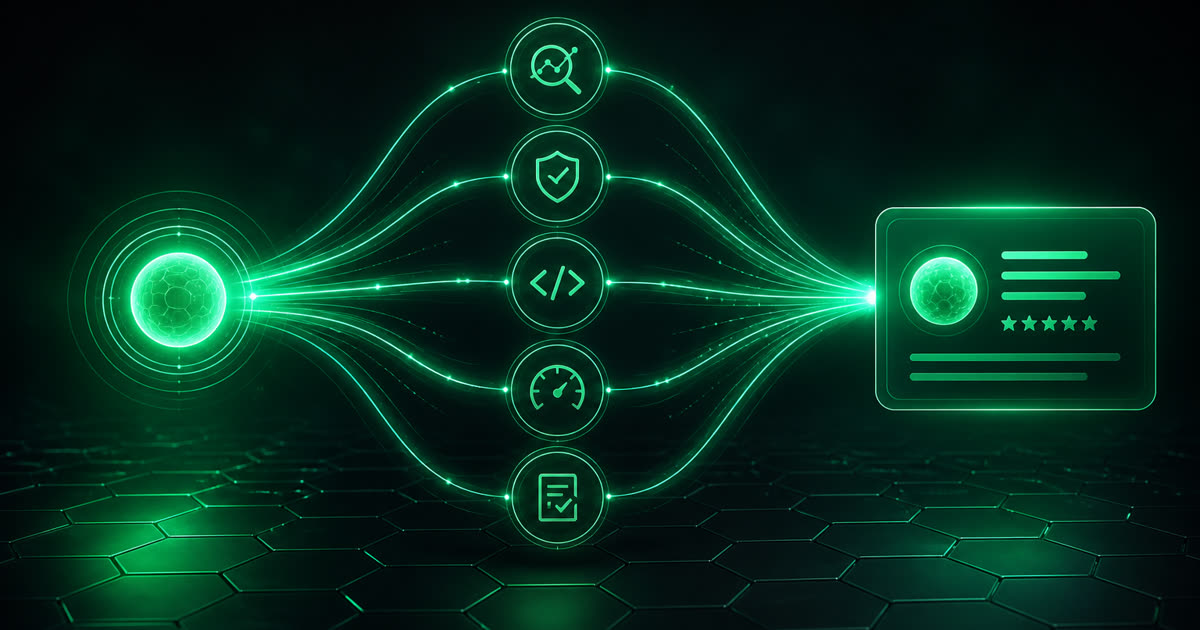
Vortex V2 is the evolution of that first cheap Core pass: specialist lanes assembled on the first review, a synthesis pass that consolidates without inventing findings, and a governance auditor that shows up when a PR will not settle.
Vortex started as one fast reviewer. That was V1: a single Core pass on every pull request, cheap enough to run on every push, honest enough to post only what it could ground in the diff.
V2 is what we built with the margin that first pass created. Not a bigger model. A fleet assembled on your first review, a synthesizer that may shrink the set and may never invent a finding, and a governance pass that shows up when the PR itself will not settle.
V1 is still the floor: DeepSeek V4 Flash on the diff, 1 credit. The August 13 A/B retired the expensive Haiku arm after 72 paired runs cut mean model cost 85.6%.
Correctness and bugs in the changed code.
V2 is not a smarter model. It is a cheaper Core, specialist coverage on the first review, a synthesizer that cannot invent findings, and a governance look at the path when the PR keeps moving. Follow-ups verify. They do not rebuild the fleet from scratch.
V1: one reviewer, then a cheaper one
The first Vortex was a generalist. It read the diff and posted a review. When we had to choose the model behind that pass, we did not guess. We ran a blind A/B on real production PRs: Claude Haiku 4.5 versus DeepSeek V4 Flash, same prompt, same context, one review delivered at random.
The fleet-study writeup is still up. The short version: on 72 paired runs, DeepSeek cut mean model cost 85.6% and posted more inline findings more often. Human votes were tiny (n=3) and we do not treat them as a win rate. Cost and coverage were enough to retire the expensive arm.
That is the V1 ending: one optimized Core reviewer, DeepSeek V4 Flash, 1 credit.
Then we spent the saving on coverage
Pocketing the whole 86% would have been the easy product. We spent a slice of it on specialists.
Each lane is its own reviewer with its own prompt and its own job. On the first review they fan out in parallel on the same head, so adding a lane does not add a serial wait. Follow-up pushes re-hire the lanes that already found something, so they can verify the fix instead of re-reviewing the world. New risk classes that appear only after that first review are still seen by Core.
- Core still owns correctness and bugs.
- Security wants a realistic exploit path in changed code.
- Performance wants a workload you can point at, not a micro-optimization.
- Architecture wants a structural defect this PR introduced or made worse.
- Tests wants the missing assertion on the new branch.
- Data wants the migration, nullability, or query that changes persisted meaning.
- API wants a wire-format break, not an internal rename.
- Frontend TS wants a concrete UI failure: a loop, a hydration break, a
as anythat nearby code already handles.
Empty findings from a lane are a good outcome. Specialists are not paid to talk.
A Core initial review is still 1 credit. Each hired specialist is 1 credit.
Synthesis: one review, not eight comments
A fleet that just concatenates is noise. After fan-out, Vortex runs a short synthesis pass.
The synthesizer sees every finding with its lane attached. It can keep, merge near-duplicates, or drop speculative noise. It references findings by index only. It cannot invent a path, a line, or a severity. If synthesis fails (timeout, bad submit, bad index), the deterministic merge stands. A consolidation failure never deletes a finding.
Core-only reviews skip synthesis. There is nothing to converge.
That is the V2 claim in one sentence: horizontal specialists on the first review, then a pass that is allowed to shrink the set, never to invent it.
Governance: a trajectory check when the PR will not settle
Some PRs do not settle. They grow, or they drift from the original ask.
On the third follow-up round and later (three or more new heads after the first review), Vortex hires Governance. Users cannot pin it. The router cannot pick it. Turning the fleet off is the only way to skip it.
Governance reads a trajectory report: the original ask, how big the current diff is versus the still-dirty slice, per-lane run history, and a digest of the prior review chain. It may open a couple of files to verify a claim. It does not re-review the diff. The other lanes already did that.
It posts exactly one finding, a verdict on the whole PR:
- Converge: name what to stop, revert, split out, or ship.
- Continue: growth is justified by the ask. That verdict is posted on the PR as an off-diff note, so you can see what the run concluded. It does not request changes, and a healthy round still ends in an approve.
Governance costs 1 credit each time it runs. On a long-lived PR that is the price of an orthogonal look at the path, not another Core pass.
What V2 is not
- It is not "we switched to a smarter model." The model got cheaper. The harness got wider.
- It is not eight independent bots on every push. The fleet is chosen on the first review. Follow-ups verify.
- It is not a quality-score leaderboard. We are not publishing a new benchmark with this post. The only measured comparison remains the August 13 A/B on Core.
- Governance is not a Settings checkbox. If the PR has not reached follow-up round 3, you will not see it.
The takeaway
V1 proved a fast reviewer could be cheap and still useful. V2 is the system we could afford after that: specialist lanes in parallel on the first review, a synthesizer that may only point at existing findings, and a governance pass that shows up when the PR itself is the problem.
The first 30 reviews are still free. Install MergeStorm and run V2 on your own stack.
Methodology note: cost and inline figures cited above are from experiment vortex-initial-ab-v1, queried 2026-08-13 (72 paired Core runs, 12 repositories, 5 users). See the original study. Specialist, synthesis, and governance behavior describe the production Vortex path as of 2026-08-22. Latency was not re-measured for this post. The A/B analysis and this writeup were generated with Fable (Claude Fable 5) and reviewed by the team.