·Mergestorm Team·Engineering
An open source Three.js RPG, built by AI agents: The Lost Storm
The Lost Storm is a free, open source Three.js RPG that runs in the browser. AI coding agents built it through 606 reviewed pull requests in four days. Play it, read the source, or fork it into your own game.
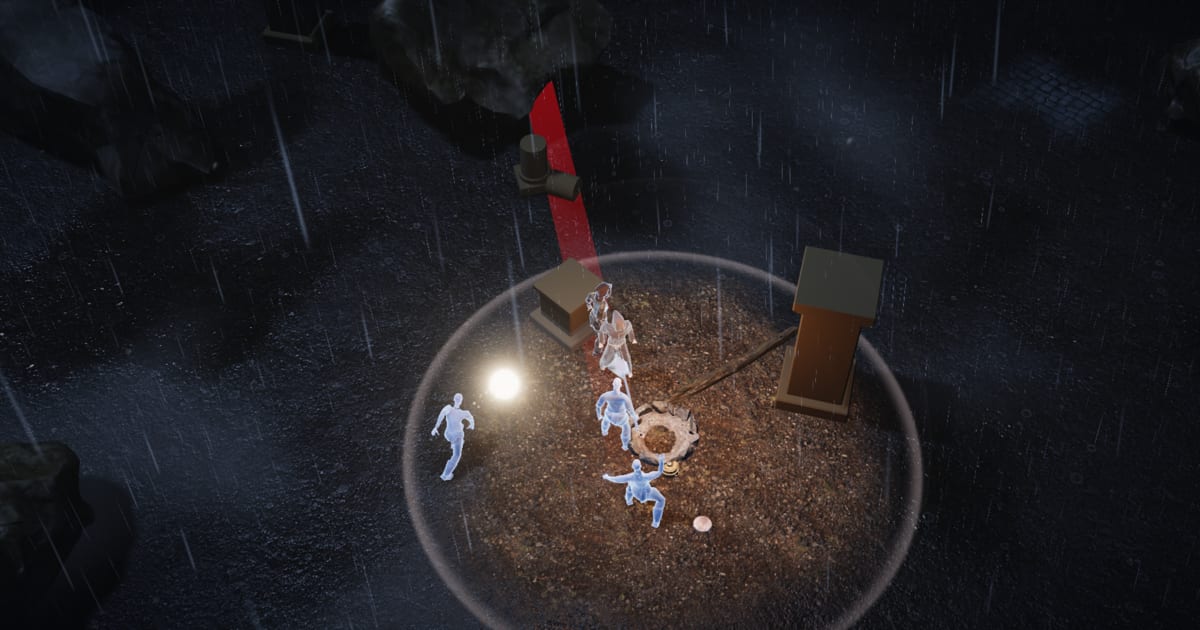
The Lost Storm is an open source Three.js RPG: a free isometric action RPG that runs in the browser, written in TypeScript with no game engine on top. It is in open alpha, the code is MIT-licensed, and you can play it right now without installing anything or signing up.
- Play: theloststorm.com/play
- Source: github.com/marginsystems/the-lost-storm
- Watch: a short gameplay clip
- Talk to us: Discord
We built it with AI coding agents, and every change went through Mergestorm: a pull request, a review from Vortex, and the merge queue. The first commit landed on November 11, 2026. Four days later the repository had 606 merged pull requests. This post covers what the game is, what is in the repository if you want to read or fork a real Three.js game, and how that many changes from parallel agents landed in order.
What the game is
You wake in the In-Between and fight your way into the Hall of Time under a night storm. At its edge there is a fire, with a trader, a stash and a waypoint.
It plays like the action RPGs you know. Click to move and to attack, pick up loot, spend points in a skill tree. The alpha has:
- Two heroes, each with their own starting weapon
- Loot with rarities and affixes: weapons, five armour slots and a charm
- A skill tree that changes how skills behave
- Bosses with phases and attacks you can see coming and walk out of
- A ladder, a shared hideout where you meet other players, and chat
- Saving in the browser, with an optional cloud copy
The first act is being built zone by zone. It is free, with nothing to buy.
What is in the repository
Most Three.js examples are a scene and a render loop. This is a whole game, so it is useful if you want to see how the parts of one fit together. The layout is strict:
| Path | What it holds |
|---|---|
sim/ | The game itself in plain TypeScript: stats, combat, skills, monster behaviour, pathfinding, loot, saving. It never imports Three.js and never touches the DOM, so it runs and is tested in Node. |
src/render/ | Three.js: lighting, the isometric camera, character loading, zones, effects, weather. It reads the world state and sends commands back. It never changes the world directly. |
src/hud/ | The interface, in DOM: globes, skill bar, inventory, skill tree, map, dialogue. |
data/ | All content as JSON: monsters, skills, items, the skill tree, rigs, zones, quests. |
Three things in there are worth copying into your own project:
- Logic and rendering are separate layers. A change to how damage is rolled goes in
sim/with a test. The renderer only draws what the simulation reports. That is why the game has a scripted player that plays the whole first act from a fresh save inside a test, in seconds, with no browser. - Content is data. Adding a monster, a skill, an item or a quest is a JSON change. If something cannot be expressed in the data, the schema is extended in a general way first. No engine code special-cases a monster by name.
- The rules are tests. One test file fails the build on a code comment, an
any, a non-null assertion, a model with no licence row, or a flat ring drawn on the ground where the shared ground-light shader should be used.
Every model and texture is CC0 or CC BY and listed with its source in ASSETS.md. The characters and animations come from Quaternius and many props and surfaces from Poly Haven. The sound effects are licensed and not in the repository, so a clone runs silent.
Fork it and make your own
git clone https://github.com/marginsystems/the-lost-storm.git
cd the-lost-storm
npm install
npm run dev
Open http://localhost:5193/play/. A plain clone makes no network request and saves to your browser.
From there the README walks through adding a skill, a monster, an item, a boss, a quest and a zone, each as data. The code and the models made for the project are MIT. The name "The Lost Storm" and its logo are not covered by the licence, so give your fork its own name.
How 606 pull requests landed in four days
These are the commits on main of the game's repository, marginsystems/the-lost-storm, per day, counted from its git history on November 14. They count commits, not pull requests, so they total 603 and do not add up to the 606 pull requests above:
| Day | Commits on main |
|---|---|
| November 11 | 28 |
| November 12 | 355 |
| November 13 | 151 |
| November 14 | 69 |
One person directed the work. AI coding agents wrote the changes, usually several at once, each in its own branch: one on the auction house, one on a new map, one on head armour, one on the opening scene.
Many agents writing code at the same time is the easy part. The hard part is what happens when their work meets. Two branches that each pass on their own can break the game together, and at 355 commits in a day nobody can read every diff or re-run every branch by hand. This is the job Mergestorm does:
- Every change is a pull request. Agents do not push to
main. A change gets a branch, a pull request and a description of what it does. - Vortex reviews every push. Pull request #1371 added five head pieces across 22 files. Vortex reviewed it three minutes after it opened and came back with three issues to fix, each pointing at a line. The agent pushed a new commit, and Vortex reviewed that one too. Vortex V2 explains how that loop is kept short.
- The merge queue lands it. When a pull request is ready, Auto land puts it in the queue, and the queue merges changes into
mainone after another, so agents never race each other tomainor merge over each other's work. Pull request #1371 was merged nine minutes after it was opened. CI runs typecheck, lint and the tests a change can reach on every pull request. During the alpha this repository has CI set to report instead of block, to keep the pace; one repository variable makes the queue wait for the whole test suite on each batch. - The repository's rules do the rest. Strict types, zero lint warnings and the rule tests above mean an agent finds out it broke a rule in seconds, on its own branch, before a reviewer has to say so.
The result is in the public history: you can open any of those pull requests and read what was asked, what Vortex found and what changed.
Questions
Is The Lost Storm free? Yes. It is free to play in the browser, with nothing to buy.
Is it really open source? The code and the models made for it are MIT-licensed. Third-party models and textures keep their own CC0 or CC BY licences. The sound files are not in the repository.
What engine does it use? None. It is Three.js for rendering, TypeScript for everything, and Vite to build.
Can I use it to start my own game? Yes. Fork it, rename it, and change the data. The README lists what each kind of content needs.
Did AI write all of it? AI coding agents wrote the changes and one person directed them. Every change went through a pull request and a Vortex review.
Try both
Play The Lost Storm and tell us what you think in the Discord. It is an alpha, and feedback decides what gets built next.
If you run coding agents on your own repository and want their work to land the same way, Mergestorm reviews every push and runs the merge queue. Every account gets 30 free credits a month; see Billing.