·Mergestorm Team·Engineering
What is a software factory? And why your AI agents need one
A software factory is the system around your coding agents: a queue of work, checks, a review gate and a merge step that turn many agents' changes into a main branch that stays green. Here is what the term means in 2026, what light and dark factories are, and the stations Mergestorm runs for you.
A coding agent can write a working change in a few minutes. Ten agents can write ten changes at once. What they cannot do on their own is get those ten changes into main reviewed, tested, in order and without breaking each other. The system that does that part now has a name: a software factory.
This post covers what the term means, what light and dark factories are, the stations every factory needs, and which of them Mergestorm runs for you.
What a software factory is
The phrase is old. Bob Bemer used it in a 1968 paper, The economics of program production, for the idea that software could come out of a standard, tooled process instead of being made by hand each time.
In 2026 it means something more specific. In February, StrongDM's AI team described how a team of three ships production software under two rules: people do not write the code, and people do not review it. Simon Willison's write-up is a good place to start. Since then the term has settled into a shape most people agree on:
- Work comes in as a queue of intent: issues, specs and bug reports.
- Many agents build at the same time, each on its own branch.
- Every change passes automated checks: types, lint, tests and scans.
- A review gate decides whether the change is right, and sends it back when it is not.
- A merge step lands approved changes on
mainone after another. - People set the intent and the rules, and watch what comes out.
A coding agent is a worker. The factory is everything around the workers that makes their output safe to ship. Addy Osmani's Software Factories, Light and Dark describes it as many agent loops running at once, with a queue in front of them and a review gate behind them.
Light and dark
The name came with a second borrowed term. In a dark factory nobody reads the code. Agents write it, machines check it, and it ships. In a light factory people stay in the loop at the points they choose: they approve the issue, read the review, or decide what lands.
Mergestorm is a light factory. Every change is a pull request you can open, every review finding points at a line, and Auto land is off until you turn it on. How much you read is your decision, and you can read less as the checks earn your trust.
The hard part moved
When people wrote every line, writing was the slow step. With agents, writing is the fast step and the queue forms after it:
- Review. Agents open pull requests faster than a team can read them.
- Collisions. Two branches that each pass on their own can break
maintogether. - CI. Every push wants a test run, and the runs pile up.
- The main branch. Ten agents trying to merge at once means conflicts, rebases and a red
mainthat stops everyone.
A better model does not fix any of these. They are infrastructure problems, and the factory is the infrastructure.
The stations, and what Mergestorm runs
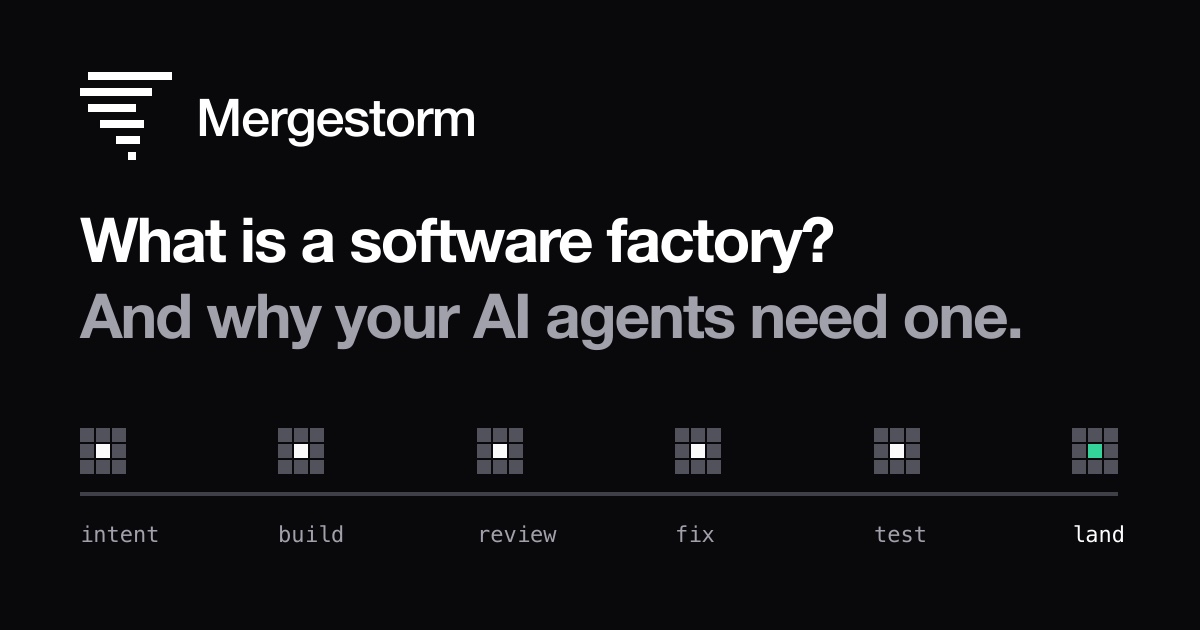
A factory is a line of stations. This is the line, and the part of Mergestorm that runs each one:
| Station | What happens there | In Mergestorm |
|---|---|---|
| Intent | An issue says what to build. It is checked against the repository before any code exists. | Vortex issue reviews |
| Build | An agent writes the change on its own branch and opens a pull request. | Breeze, or your own agents |
| Review | Every push is read against the codebase, the diff and the linked issue. | Vortex |
| Fix | Clear findings are patched and committed to the branch. | Cyclone |
| Test | CI runs on runners that start when there is work and shut down after it. | Surge |
| Land | Approved changes merge one after another. | Stacks, Auto land and the merge queue |
Some detail on each:
- Breeze is the builder for people who do not want to run agents themselves. You describe what you want in a chat. Breeze plans it, builds it and shows you the result, and later changes arrive as pull requests that get reviewed. Build a free website with AI walks through it.
- Vortex reviews every pull request on every push. It reads your codebase, the diff and the linked GitHub issue, then posts inline comments and a GitHub check. With issue reviews on, it also reviews the issue itself and posts a verdict before any pull request exists, so a plan that contradicts the code is caught before an agent builds it.
- Cyclone is optional. Install it if you want fixes for review findings committed to the branch for you.
- Surge gives a private repository on-demand GitHub Actions runners that scale to zero. The Surge post explains how.
- The merge queue lands pull requests one after another, so agents never race each other to
main. With batching on, it tests several queued pull requests on one CI run, lands them one by one, and checks after each land that the base branch holds exactly the tree the batch tested.
The stations come as three GitHub Apps. Install only the ones you want: Vortex for reviews, Cyclone for patches, and Mergestorm Surge for the CI runners, stacks, Auto land and the merge queue.
Bring your own agents
The factory is for your agents, whichever ones you use. Two interfaces put the line in an agent's hands.
The mg CLI works anywhere an agent has a shell:
npm i -g mergestorm
mg login
mg stack create fix/login-redirect
git commit -am "Fix the login redirect"
mg stack submit
The MCP server, mergestorm-mcp, gives the same line to agents that speak MCP, such as Claude Code and Codex:
claude mcp add --transport stdio mergestorm -- npx -y mergestorm-mcp
With either one, an agent can open an issue and wait for the verdict, submit its pull request, wait for the review, fix what Vortex found and follow the stack until it lands. The agent does not need to poll GitHub or guess when it is done. Stacked PRs from your terminal covers the CLI.
A real run
We built a game to find out whether the line holds. The Lost Storm is an open source Three.js RPG. Its first commit landed on November 11, 2026. Four days later the repository had 606 merged pull requests. One person directed the work and AI coding agents wrote the changes, several at a time.
Every one of those changes took the same path: a branch, a pull request, a Vortex review and the merge queue. One pull request that added five head pieces across 22 files was reviewed three minutes after it opened and merged nine minutes after it opened. The history is public, so you can read what was asked, what Vortex found and what changed.
This post took the same path. It started as an issue, Vortex approved the issue, an agent wrote it, and the merge queue landed it.
Start your own
You do not have to build a factory to have one.
- Sign in at mergestorm.ai. Every account gets 30 free credits every month, with no card required.
- Install Vortex on a repository and open a pull request. How it works shows the loop on a real pull request.
- Add stations as you need them. Cyclone when you want findings patched for you, Mergestorm Surge when you want the merge queue, Auto land and CI runners. The docs cover every setting.
If you would rather describe what you want and let us run the whole line, start with Breeze.
Your agents do the work. The factory makes it land.